Posts

Showing posts with the label projects

UVG Presentations

Image
On Friday, June 16, we went to the Universidad del Valle de Guatemala to give presentations on our research to a group of students who are interested in studying Mayan languages. There were five student presentations and one workshop. The goal of the presentations was (i) to show the local student community the different things that we were working on while in Guatemala and (ii) to get feedback on our work. It was a really great lesson in presenting in our non-native language (Spanish), and also gave us experience in presenting our work to non-linguists. Irine Burukina presented first and discussed the idea of Universal Grammar in regards to Mayan languages and their similarities to, and differences from, other world languages. Her research talked about the similarities between reflexives in Kaqchikel, English, Hungarian, and Spanish, and the differences in quantifiers among the same four languages. Irine at UVG Then, Justin Royer presented his current research on definite and...
About our native speakers and elicitations

Image
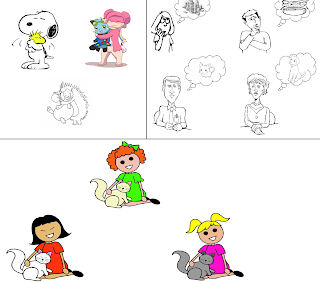
I wanted to write this blog post about some technical issues of linguistic field work but it turned out to be mostly about the speakers just because all my work would have been impossible without them. On the second day of the field trip this year, I started doing elicitation with my host mother Señora Irma and yes, she is an amazing consultant! As a medical worker, she is very busy during the whole week but she still found time to work with me almost every evening. She was patient and concentrated and, thanks to her, we could work with the most difficult examples using the pictures (try to decide for yourself how many interpretations a sentence like At least three girls saw some cats has ). Pictures for elicitations on quantifiers The f irst elicitation and the first attempt to write in Kaqchikel were hard and exhausting. Th e second elicitation was a surprise: Kaqchikel translations from Spanish provided by Se ñora Irma contradicted almost all the existing data abo...

Documenting Kaqchikel Ritual Language

Image
Last Sunday, I traveled to Sumpango to launch a very exciting project, in collaboration with Yolanda Estrada and a group of Kaqchikel Ajq’ija’ (Spiritual Guides) led by Delfina Solloy and Valerio Toj. The group is called Waqxaqi’ B’atz’ and is comprised of several guides from Sumpango and Santa María de Jesús, who meet every three weeks for a ceremony. Yolanda, who is a professor of history at Universidad San Carlos de Guatemala (USAC), has been working with Waqxaqi’ B’atz’ for over a year, documenting their educational practices and life philosophy. This year, we were awarded a grant from the Firebird Foundation to help the guides record their ceremonies from June-August. Camera 1 Recording The primary purpose of the project is to ensure that this special type oral tradition is preserved forever; we will thus provide the guides with a thorough documentation of their ceremonies (audio and video), so they can use the recordings in the future for the training of new guides ...

Log 14: Presenting our work!

Image
On June 29 th , we made our way back to Universidad del Valle (UVG), altiplano campus in Sololá, to present the results of our research in Tecpán and Patzún. This part of our trip was particularly important, since we wanted to showcase what we’d accomplished in a short period of time and also encourage/invite UVG students and scholars to work with us in future trips. One of the main drives of the research station is to create opportunities for researchers like us and local students to collaborate across disciplines, so it was crucial that we piqued the attendees’ interests. Rehearsing the talks at Pedro's in Patz ún Following opening remarks by Pedro and Omer, we each gave the following talks—Gesoel and I’s was a joint endeavor, so we got to give a more detailed account of our data: RESEARCH PRESENTATIONS a.         Gesoel and I : Extracción de Adjuntos en Kaqchikel y Tz’utujiil ( Adjunct Extraction in Kaqchikel and Tz’utujiil )...

Flyer for our presentations at UVG-A

Here is a link to the flyer that Pedro has prepared for our presentations on June 29 at UVG-A (Universidad del Valle de Guatemala, Campus Altiplano).

Log 10: Kaqchikel and Tz'utujiil Elicitation

Image
Gesoel and I have had the pleasure to work with several speakers of Kaqchikel and Tz’utujiil for our project exploring the distribution of /wi/ , which has been described as a post-verbal focus particle in Kaqchikel. We first interviewed Doña Toya in Tecpán. Doña Toya hosted Emma for two weeks, and will be welcoming her back to her home after our Patzún adventure. Doña Toya is a very enthusiastic person who loves to share her knowledge of Kaqchikel; to summarize some of our findings for her dialect, Doña Toya rejected the /wi/ particle in many of the environments in which it has been reported to be obligatory in the literature—for instance, we expected /wi/ to occur obligatorily after the verb upon the extraction of a locative, but she rejected it outright: (1)  X-Ø-tzopin           Lolmaay chwa jay.        COM-B3s-jumo   Lolmaay backyard        'Lolmaay jumped in the yard.' (1') Akuchi’   ...

Log 4 - Trip to Universidad del Valle

Image
On Saturday the 4 th , the group headed up to the altiplano campus of the Universidad del Valle de Guatemala (UVG). The campus is located in a vast terrain of protected land in Sololá, midway from the highway to the state capital. According to my host mom Doña Nati, the area was used as a military base during the civil war, until the land was abandoned and given to UVG following the signing of the Peace Accords, in order to establish the satellite campus. The university offers classes throughout the week, focusing on education, tourism, and environmental engineering. Solol á  on a clear day The most important task of the day involved presenting our plans for the field station to UVG faculty and students. The activity began with some much needed coffee, after which Pedro gave a talk on the basic structure and goals of the field station, emphasizing in particular the collaborative nature of the endeavor, within linguistics proper and beyond. One of the special aspects of t...