Posts

Transcription in Kaqchikel. My Experience

Image
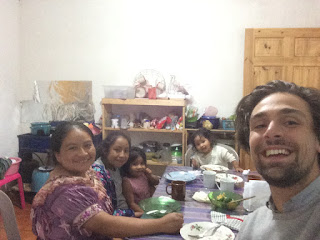
Something incredible that I learned while on this trip to the UMD Guatemala Field Station this summer is that simply talking with someone about their day can reveal unique oral narratives. Recording, transcribing, and translating these narratives can aid in the preservation of the storytelling methods in the language that one is studying. in my case Kaqchikel. For my host Doña Güicha and I (and for many people around the world), asking about the happenings in each other’s days is usually where our conversations would begin after a long day of work. I wanted a chance to document those interactions, so I made this recording while we sat together, watching the tortillas heat up on the wooden stove top. In the background the youngest member of our family, 7 year old Daniel, plays with the chair (and occasionally screams). We had spent many nights like this while I was in Patzún, but this had to be one of the most memorable. Tia Güicha, as I fondly called her, is pictured here. She spe...

Host Family and Homestay

Image
On the first day of classes, I got sick. I’d followed all the instructions about the water and hadn’t eaten anything suspicious, but there isn’t much to do about Patzún’s 2.250m of elevation. It had been barely more than 24 hours after meeting the family I was staying with, but before I could do much my host Marta was at the pharmacy with me, making me chicken soup and checking up on me in my room. Before even getting to know me, the whole family was mobilized to make sure I was doing ok. Initially, I thought this attention was because I felt unwell, but after I while I noticed they were genuinely interested in making me feel at home. Every night at dinner the whole family would ask questions about my day, they’d help me remember the Kaqchikel I learned in class and ask me to talk about life in Brazil. As time went on, dinner became one of the most important parts of my day. I quickly became good friends with my host family and they were always excited to share stories and ask que...

Kaqchikel For A Speaker Of... Not Spanish

I studied French in school. And ASL. And Mandarin. But, despite living my entire life in Florida, a state with a huge community of Spanish-speakers (including some in my own family), I had never studied Spanish. I applied to the Guatemala Field School thinking that I would not be accepted, as a direct result of this fact.  When I was  accepted, I arrived in Guatemala with virtually no knowledge of Spanish. I could read passably, but every time someone spoke to me I could return only a blank stare. I could say "Hola" and count to ten, but those weren't doing me much good. My host family speaks primarily Kaqchikel, but they codeswitch frequently to Spanish as well. They have been accepting and patient as I have struggled through, with one memorable example being when I told them "I don't want your clothes" a week in. I was trying to communicate that I didn't want to be culturally appropriative by wearing their traditional clothing, after they asked. ...

In search of the real Kaqchikel

Image
In contrast to most students who attended Guatemala Field Station this year, my background is in nutrition rather than linguistics. I am a registered dietitian/nutritionist. I arrived in Tecpán, Guatemala three months ago to begin a year-long fellowship with the  Maya Health Alliance/Wuqu Kawoq , a non-government organization that provides mostly home-based health care in Mayan languages. The fellowship is sponspored by the Academy of Nutrition and Dietetics Foundation . To me, learning to speak local languages is important in order to break through cultural barriers, build trust with patients/clients and to see the world in new ways. You can read more about my interest in languages on my blog www.indigenouslinguist.com . Pictured Above: Guatemala Field Station Teachers Lajuj Batz (Left) and Ixkamel (Center) This year, I set a target for myself to speak the Mayan language of Kaqchikel at 80% fluency by the end of my fellowship. There is only one small problem with this goa...

How to help victims of the Fuego volcano eruption

Image
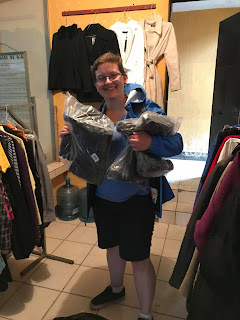
Volcán de Fuego , less than 20 miles southeast from where we are in Patzún, began erupting around noon on Sunday, and continued with fresh eruptions this afternoon . Pyroclastic flows, which can travel at over 100mph, are burying people and towns. The official death toll so far is 70, but hundreds or thousands of people are still unaccounted for, and thousands have been displaced from their homes. The news here is a constant cycle of horrific death and destruction. Here in Patzún, we're doing what we can by donating clothing, shoes, and toiletries for rescue workers, survivors, and evacuees. Isabel's host mom, Doña Gloria, and her two daughters helped us find the right stores to buy everything, and helped us carry all our bags to a church that was collecting donations. (A quetzal goes a long way here--we were limited only by what we could carry!) Emily with an armload of boots. Akshay and I carry bags to the church  with Isabel's host family. You can help ...

Learning Kaqchikel with Ixkamey and Lajuj B'atz'

Image
Xseqër k'a! Buenos dias! As previous field school participants have noted , the immersive Kaqchikel classes are intense. Our instructors speak almost exclusively in Kaqchikel, and we don't use a textbook or other written demonstrations during class. I joined the class on the fourth day. My only preparation was the first lesson of this short online course , so all I knew was a few greetings, yes and no, and thank you. I didn't know what to expect, and I was worried that I'd be too far behind to catch up. Instructor Lajuj B'atz' plays  sakonel , with Ixq'anil  (Polina) as his client. No hairstyles were harmed in this  language lesson.  The class began with an exchange of greetings (yay, I understood that part!), and then launched into a review of the previous day. Before I knew it, my classmates were howling and crawling and hopping around: turns out we were reviewing vocabulary for animals. In a typical language class, the teacher would pr...

Welcome to Field School 2018!

Image
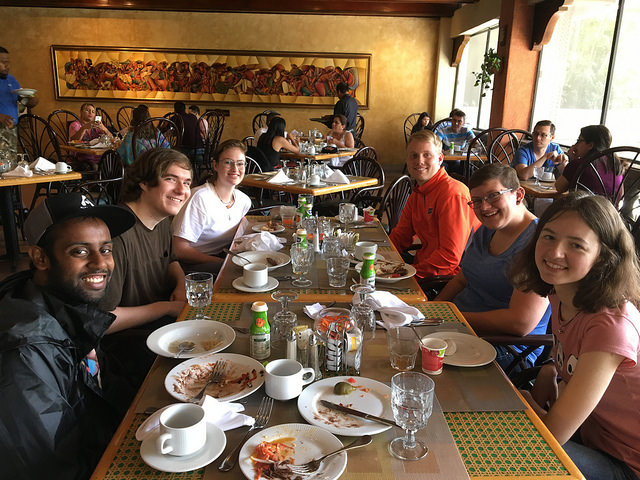
We've already finished the first week of this year's field school, so we have a lot to catch you up on! This is the third annual trip to the Guatemala Field Station  in Patzún for the summer field school .  Students and faculty visit Patzún for a month, including two weeks of intensive language classes and two weeks of mentored research and data collection. Last weekend the first group of linguists arrived in Patzún and settled in with their host families. On Monday, they began the immersion course in Kaqchikel. It's a diverse group of students from different universities and stages of training: Akshay Aitha just graduated from UC Berkeley with a BA in Linguistics and Applied Math.  Caleb Ewing is a graduate student in Linguistics at the University of Florida. Brecken Keller is an undergraduate student at the University of Maryland, majoring in Linguistics and Computer Science.  Polina Pleshak is a graduate student in Theoretical and Applied Linguistics at...

Final Post 2017

Image
We've all safely arrived back in our homes after a wonderful adventure to Patzún. A big thank you to our host families, to Wuqu Kawoq, to our teachers, to our tireless consultants, and to the tireless Pedro Mateo Pedro for the amazing experience. Thank you for reading the blog and we look forward to next year's trip! Matyöx!

UVG Presentations

Image
On Friday, June 16, we went to the Universidad del Valle de Guatemala to give presentations on our research to a group of students who are interested in studying Mayan languages. There were five student presentations and one workshop. The goal of the presentations was (i) to show the local student community the different things that we were working on while in Guatemala and (ii) to get feedback on our work. It was a really great lesson in presenting in our non-native language (Spanish), and also gave us experience in presenting our work to non-linguists. Irine Burukina presented first and discussed the idea of Universal Grammar in regards to Mayan languages and their similarities to, and differences from, other world languages. Her research talked about the similarities between reflexives in Kaqchikel, English, Hungarian, and Spanish, and the differences in quantifiers among the same four languages. Irine at UVG Then, Justin Royer presented his current research on definite and...

Tecpán: One year later

Image
In the grand scheme of things, Patzún and Tecpán are a lot more similar than they are different. They're both relatively small cities (pop: ~20k) in the Guatemalan Highlands separated by only a 40 minute trip on the highway. But after three weeks in Patzún, Tecpán felt like a world apart. On Monday, June 19th Paulina and I took the short trip in the afternoon to reconnect with our host families from last year. Unlike this year, where we spent the entire month of the Field School in Patzún, last year's Field School was split - 2 weeks in Tecpán learning Kaqchikel in the Wuqu' Kawoq offices, followed by 2 weeks in Patzún doing fieldwork. As some of the only returning members from last year's trip, we thought it'd be nice to pay a short visit to our host families in Tecpán. Me with my Tecpán host family (Doña Mercedes and Don Pedro) - June, 2016 The most noticeable differences between Patzún and Tecpán is the population, officially Tecpán is bigger by just 3,00...

Field Work Recipe: Lava-roasted Marshmallows and Chocolate Chip Cookie Smores

Image
Prep Time: 4~ hours (2 hours driving from Patzún, 2 hours hiking, 5 minutes cook time) Equipment 1 accessible heat vent on an active volcano (I used Pacaya) Stick for roasting marshmallows Hiking shoes/boots Spending money for the Lava Store Drinking water (and lots of it!) Ingredients Marshmallows Chocolate chip cookies Instructions Acquire your chocolate chip cookies and marshmallows a day in advance. If you can't make your own, store-bought is fine (Maxi-Despensa in Patzún carries Jet-Puft and Chips-ahoy). Rise at 4am and catch the 4:30 chartered bus from Patzún to Pacaya. Watch the sunrise over the milpas in Patzicia. Upon arrival at Pacaya, avoid the offers of "taxis" (horses)  at the base of the volcano. That's cheating. Take the kids up on the offer of a hiking stick though. Find your guide. He should be wearing a green vest and a Parque Nacional Pacaya badge. Set off up the volcano for 2.6km at 60°F in June, temperature may vary depe...

About our native speakers and elicitations

Image
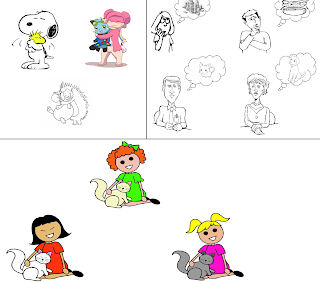
I wanted to write this blog post about some technical issues of linguistic field work but it turned out to be mostly about the speakers just because all my work would have been impossible without them. On the second day of the field trip this year, I started doing elicitation with my host mother Señora Irma and yes, she is an amazing consultant! As a medical worker, she is very busy during the whole week but she still found time to work with me almost every evening. She was patient and concentrated and, thanks to her, we could work with the most difficult examples using the pictures (try to decide for yourself how many interpretations a sentence like At least three girls saw some cats has ). Pictures for elicitations on quantifiers The f irst elicitation and the first attempt to write in Kaqchikel were hard and exhausting. Th e second elicitation was a surprise: Kaqchikel translations from Spanish provided by Se ñora Irma contradicted almost all the existing data abo...

Wedding in Patzún, June 10, Saturday

Image
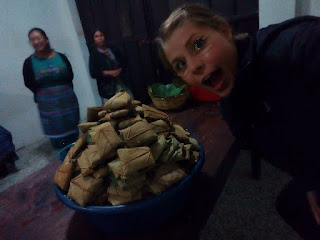
Yet another fiesta in Patz ún – a wedding. Many of our host families are related to either the bride’s or the groom’s side, and by extension – as their ‘kids’ now - we were invited as well. We know Guatemalans like to celebrate in style so were very excited to see what a big deal a wedding is. We were not wrong. The wedding was planned for Saturday but preparations started way ahead of time – Thursday morning. The majority of tasks are done by the groom’s side and those of us who fell in that group were expected to help out just as any other member of the family. We polished leaves for chuchitos, wrapped tamalitos, stirred estofado (tested them all too) and hanged decorations together. The Patzuners welcomed us very warmly, shared all their how-to’s and occasionally laughed at our Kaqchikel attempts. It felt like a very important social bonding experience with a good deal of friendly gossiping, teasing and story-telling.   The day of the wedding was very hectic ...

¡Matyöx chawe Gilda!

Image
¡Xseqër! This blog post is about my host mother. I think it makes sense to talk about her and her wonderful family because there’s no doubt that the success of this field station goes hand in hand with the exceptional quality of the families that welcome us into their homes.  My host mom is a superhero. Mother of three beautiful and (almost all the time) well-behaved children, she holds various different jobs, multitasks practically everything, and is devoted to many political and sociocultural issues related to indigenous women’s rights, Mayan identity, and culture in Guatemala and Patzún. Gilda (who agreed to have her name published in this blog post) is a very active person. Every week, she helps her mother at the family business, which makes the best chiles rellenos in town. She also spends a lot of time and energy working for a cooperative of indigenous women called Ajsu’m. This cooperative not only provides a community of women with work, but also aims to offer works...

Documenting Kaqchikel Ritual Language

Image
Last Sunday, I traveled to Sumpango to launch a very exciting project, in collaboration with Yolanda Estrada and a group of Kaqchikel Ajq’ija’ (Spiritual Guides) led by Delfina Solloy and Valerio Toj. The group is called Waqxaqi’ B’atz’ and is comprised of several guides from Sumpango and Santa María de Jesús, who meet every three weeks for a ceremony. Yolanda, who is a professor of history at Universidad San Carlos de Guatemala (USAC), has been working with Waqxaqi’ B’atz’ for over a year, documenting their educational practices and life philosophy. This year, we were awarded a grant from the Firebird Foundation to help the guides record their ceremonies from June-August. Camera 1 Recording The primary purpose of the project is to ensure that this special type oral tradition is preserved forever; we will thus provide the guides with a thorough documentation of their ceremonies (audio and video), so they can use the recordings in the future for the training of new guides ...

Visit to Iximche'

Image
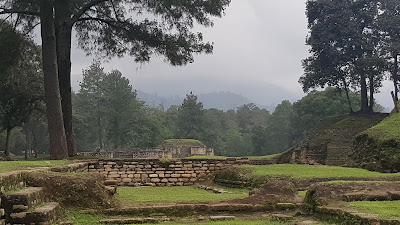
This weekend we visited the ruins of Iximche’, the former capital of the Kaqchikel people. The city features Post-Classic Maya architecture, and was built in 1470. It was the Kaqchikel capital until the Spanish took over in 1524.  It has four main plazas and two ball courts. A few of the pyramids have been fully excavated, and there are many more which are still partially buried under centuries’ worth of dirt.  Map of Iximche' Locals also come to Iximche’ to perform ceremonies and leave offerings of food. There is one pyramid at the back where ceremonies happen. There is also a small museum, and a stela at the entrance. The stela was built by Kaqchikel artists and historians in 2012 to commemorate the passing of the oxlajuj b’ak’tun (thirteenth unit of 400 years). The glyphs on the stela describe the dates of eight important Kaqchikel historical events that have happened in the past several hundred years.